
Monarch butterfly tagging update

April 2026
We are a few weeks on since I wrote about tagging. The second tagged butterfly I reported seeing in the garden, which originated in a property 300m up the road, visited multiple times and all of those visits have been logged using the reporting website mb.org.nz What is very cool is you get an automated email telling you where the monarch your saw originated and when it was released. Even cooler is that there is a link to a map. I am the only person who has reported seeing this particular butterfly, but it definitely has not been in my garden the whole time. There was a full week between the second and third sightings. It went somewhere...
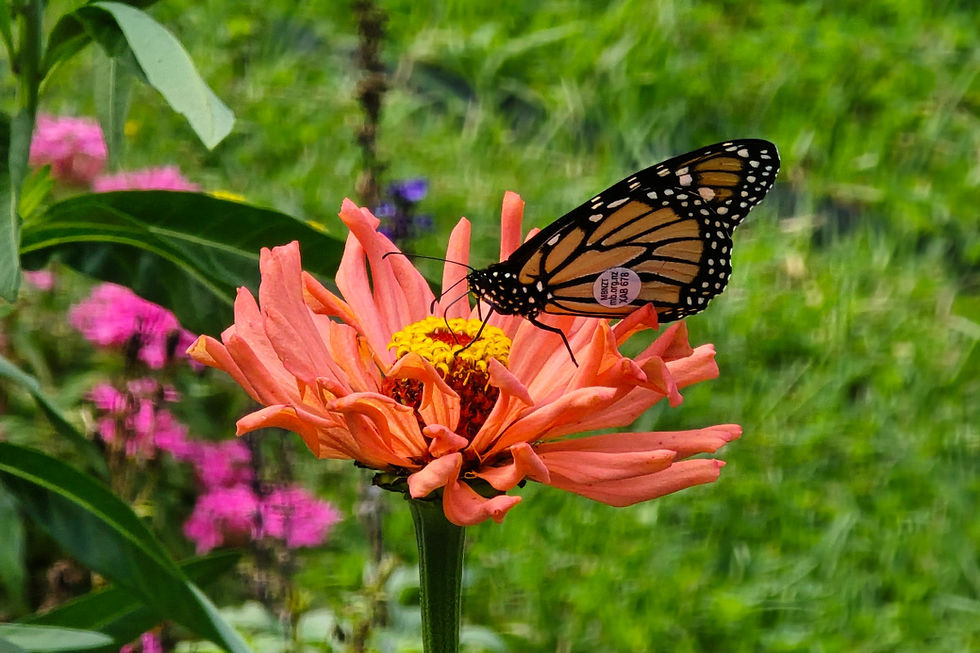
I have now met the tagger up the road whose butterflies made it to my garden. I girded my introverted loins and went round to introduce myself. Our homes are not within line of sight, despite being on the same road. Her butterflies may have flown against the topography (is that the right word?) of the landscape to come to mine - across a housed valley, over a forested ridge, across another valley, over another wooded ridge and then dropped into the valley our house lurks in. It's actually amazing when you see the contours on a map. I can only assume the butterflies followed the gardens along the road instead, despite it being a mix of the very clipped and tidy, bush gardens and mixed gardens, which makes it a longer journey, but more logical.
In the previous tagging article I had laughed at myself for imagining that a butterfly might find my garden, having been released suburbs away. Well, turns out...

The tagged monarch I saw in the garden minutes after I published the last blog post definitely had comic timing. This monarch started out about 4.5kms away on the far side of Northcote. It travelled across a heavily residential area, with the hazards of traffic, garden and pest chemicals, and possible predators. When I imagine the monarch butterflies that travel long distances, I picture them high in the air, using wind currents, but given this shortish distance, I can only imagine it was done at relatively low levels, the same as local birds, with all the dangers that brings. I was so happy to see this one, I kept telling people around me who were not at all interested.

As for tagging myself? Whilst I mean me tagging a monarch, I managed to actually avoid tagging myself, but only just. I got a do-not-use sticker stuck to me somehow instead. We had been away for a few days for Easter and I am not completely sure when the monarch came out, so I tagged it immediately. I was worried about handling the butterfly, despite watching the MBNZT video multiple times. She was feisty, which is going to be useful as one of the autumn generation. Still, I got it done with nothing but my nerves the worse for wear and we'll see if anyone spots her or the few more that are yet to eclose. If they turn up in my own garden again, I'll log those as sightings (which will mean they didn't go anywhere or they returned "home").

One of the benefits of tagging monarchs in captivity is that you can control the environment you are tagging in and the age of the butterfly is accurate when it is seen again. In the States wild butterflies are also tagged by capturing them in soft butterfly nets at reserves and butterfly waystations, tagging them and then releasing them. This is because they are interested in migratory routes, which we already know do not exist in New Zealand. The NZ tagging system allows for that approach too, but my nets are cheapies bought for stomping on wasps, and are not suitable for a butterfly's delicate wings.
My butterflies are from eggs I found in the garden and then raised, but from now on, I'll (try to) leave eggs alone, trust the wasp calendar is right and that the monarchs can now develop normally, wild within the garden. I'll capture them just before metamorphosis for tagging purposes. I saw a female laying eggs last week, which should be the last full Auckland generation of this butterfly season. However, the last lot of eggs that were laid mid-March all disappeared. Ants maybe? The urge to interfere is high. For now I'll keep a watching brief.
So why the tagging? The Moths and Butterflies of New Zealand Trust are particularly interested in finding out where monarchs overwinter. Given it is believed that the same places are used again and again due to chemical markers left by previous butterflies, where actually are they and how far will monarchs travel to congregate at one of these sites? Hopefully this year's tagging exercise will shine a light on more locations, but only if we all keep an eye out for tagged monarchs.
Have your camera handy near colourful flowers or swan plants and log the details!


Comments