
Paper wasps in the garden in winter

Updated: Sep 9
Two paper wasps in one day. It sounds like a bad take on a Crowded House song. It certainly is enough to change the mood of a garden walk.
I saw the first wasp in an MPI trap on the school run, likely caught in the last few days. The other was in my own garden - an Asian paper wasp working over a small lump of protein, probably a fly.
That could mean one of two things. The Asian paper wasp is a foundress (what a queen paper wasp is called) and needs protein liquid before producing eggs, in much the same way that a female mosquito drinks our blood. It can also mean the wasp is breaking down food for larvae back at the nest.

This feels awfully early whichever it is. Given the time of year, it is more likely that the foundress is getting ready to lay eggs rather than already having young to feed. Even so, if a nest is already established, the work to remove them from the environment needs to start now. Once workers emerge, the job gets harder, and the pressure on garden insects increases.
Paper wasps are predators. They take flies, caterpillars, moth larvae and other small insects. Some of that might sound useful, but they do not sort the “pest” insects from the native or beneficial ones. In my butterfly and wildlife garden, that matters.
Recent research suggests perennial nests
I was shocked to see wasps - any wasps - this early. It's not even spring yet. I thought the pattern was that for all types of invasive social wasp, the new queens that mated at the end of the last season hibernate for the winter. They then emerge in spring to set up new nests or build on old ones. However, in looking for research around wasps, rather than anecdotal information online, I found a paper published a few months ago by Victoria University researching winter activity of Common and German (vespula) wasps and European paper wasps. It found wasp activity throughout the winter and throughout the country. Yep, even in the parts of the South Island where temperatures drop significantly.
Not only did they find evidence of all three species being winter active, they identified some of those wasps seen were workers. This goes against the traditional understanding of wasp life-cycles in New Zealand where all the workers die off. One of the possibilities is that there are nests where there this doesn't happen - perennial nests - with year-round activity, albeit at a much reduced rate in winter. The other is that the wasps are responding to shifting seasonal changes, giving them a longer active period.
Whatever the reason for this winter activity, it has knock on effects for pest management. It's time for me to get the nets out.
Reducing wasp numbers at the start of the season
A lot of wasp control advice starts with traps. That makes sense for vespula wasps at certain times of the year, especially where bait suits their feeding habits. It does not solve the paper wasp problem.
Paper wasps are not strongly attracted to standard wasp traps because they are hunting fresh meat, not scavenging carrion. They are looking for live insects to feed larvae and protein wasp bait is based on carrion mimicry (which is probably why some of them smell really rank!) I know MPI were using a mixture of carbohydrate and protein baits last season to widen their chances of capturing the hornets.

We only have manual interventions as a way to control paper wasps. It is time and labour intensive, but spending the time at the start of the wasp season really makes a difference to local numbers. Whilst we had wasps in the garden all last season, I really only felt they were overwhelming at the height of summer. That's because I put the work in last September and October to take out as many wasps as possible.
The most efficient way is to find the early nests and destroy them and the wasps resting on them at dusk when the daytime insects are at rest and the night-time insects haven't emerged in numbers.
How to find a paper wasp nest
Advice online suggests following a wasp with prey home to find the nest. I have never been able to do that. Wasps can fly in a straight line over hedges and trees and I certainly cannot. However, checking the places around your property where a nest is more likely to be is a good way to find them.
Good nest locations to check include:
Under deck rails, bench seats and outdoor tables
Beneath eaves, gutters and roof edges
Inside shrub canopies, especially sheltered ones
On fence rails, pergolas and trellis
Under pot rims and garden ornaments
Around compost bays, wood piles and stacked materials
Beneath leaves of dense plants such as flax or large perennials
Paper wasps like dry, sheltered places. They often choose spots with a little cover overhead and a clear flight path in and out. I talked to one environmental consultant who swore they always nested in the plastic tubing that goes around the base of newly planted trees. If you read my wasp diatribe, I mean blog post last spring you'll know I found the start of a European paper wasp nest in my car. I still can't get over the cheek of that.
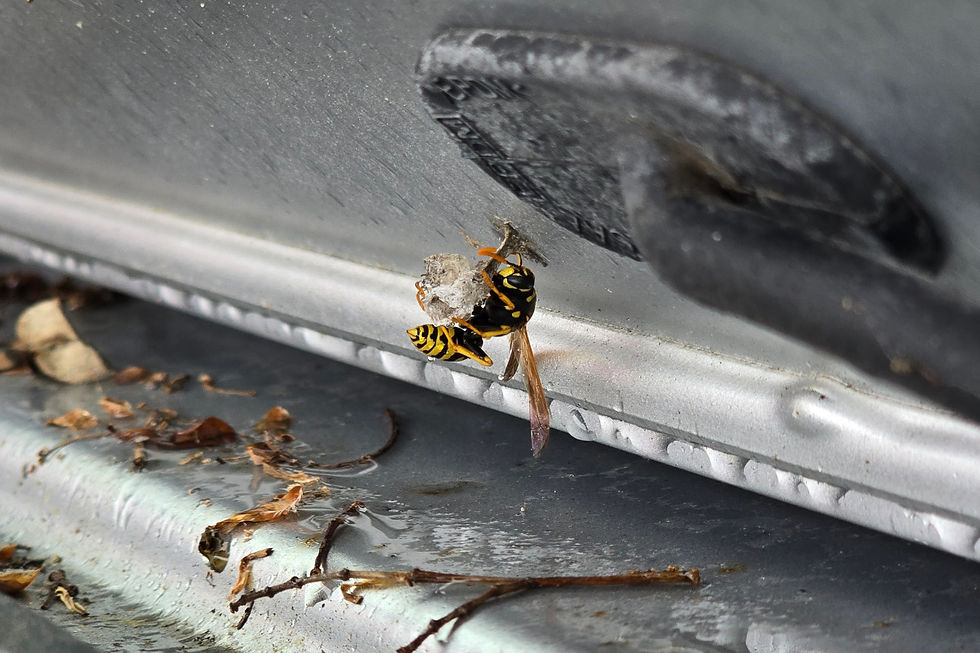
I favour the "fly spray at dusk and run away fast" approach to paper wasp nest removal, but I always go back and destroy the physical nest the next day so it can't be used by other wasps. I know the more excitable element of NZ likes hair spray and a lighter. I don't recommend it, but as long as you don't set fire to the neighbourhood and you take care not to harm yourself or others, we need to take these nests down one way or another.
Netting a result
What is not efficient, but does get results, at least early in the season, is using nets to capture individual wasps and then stomping on them. Because these are likely to be queens or foundresses, you are stopping the nest from developing without the need to actually find or access the nest. It makes less difference once the worker numbers are building up, but it does still feel like you are fighting back. You can get cheap kids nets from the local $2 shop.
I was hoping that I would not need to start the anti-wasp preparations for another fortnight or so, but at the start of the season every wasp counts. I'll need to dig the nets out of storage at the weekend and put them within grabbing distance at wasp hotspots around the garden.
I never thought I'd be saying this in winter, but I hereby declare the 2026/2027 New Zealand wasp hunting season open!
Reference:
Anastasi, Maëlle & Bulgarella, Mariana & Anastasi, J. & Lester, Phil. (2026). Exploring distribution, caste-specific seasonality, and winter activity of three invasive wasps (Hymenoptera: Vespidae) in New Zealand using citizen science data. Insectes Sociaux. 10.1007/s00040-026-01099-5.


Comments